Showing posts with label weight loss. Show all posts

Monday, 12 November 2012

The Mediterranean Diet


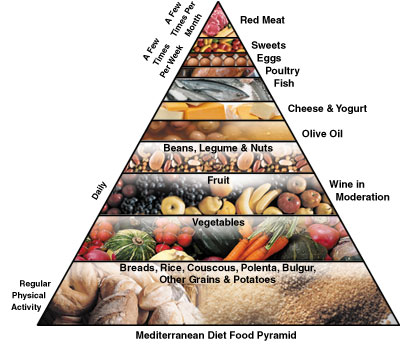
The Mediterranean diet describes the diet followed by those living in the countries surrounding the Mediterranean Sea.  Over the last few years it has become impossible to ignore that some countries have increased rates of obesity while other countries are as healthy as ever getting health benefits from their daily diet.
                                                  

Eating the Mediterranean style may not only help you to shed a few kilos (by cutting fats, refined carbs and processed foods) and keep your heart healthy but is extremely tasty too.
Basics and benefits of the Mediterranean diet:
1.       Replacing fatty meat cuts with oily fish at least twice a week. This leads to the replacement of saturated fats with unsaturated fats which reduces your total cholesterol as well as LDL (bad cholesterol)
2.       Eat mostly plant based foods such as fruits, vegetables, whole grains and legumes. This will :
-          Replace salt and fat laden food in your daily diet.
-          The fruit and vegetables will reduce high blood pressure with the help of Potassium and Magnesium.
-          Increase fiber in your diet keeping you fuller for longer, help normal gut functioning and lower cholesterol
3.       Replacing saturated fats such as butter with healthy extra virgin olive and/or canola oil. Even bread is merely dipped in olive oil rather than spread with butter and jam as many of us do.
4.       Foods are full of flavor by using herbs instead of spices, decreasing the salt content of the diet.
5.       Moderate consumption of red wine is known to fight heart disease.
Tips from the GLD to incorporate the Mediterranean habits into your daily diet:
1.       Eat at least 5-a-day of colorful fruits and vegetables. Fruits can be used as snacks while vegetables can form the basis of main meal.
2.       Snack on plain, unsalted nuts. A closed handful would form a snack portion. Choose almonds, walnuts and pumpkin seeds.
3.       Use very little fats and when using fats, use only olive oil in its uncooked state.
4.       Add flavor with lemon juice, garlic, tomato and loads of fresh herbs to keep the salt intake low.
5.       Eat fatty fish such as salmon, tuna and sardines at least twice per week.
6.       Have a glass of wine. No more than 1 glass (130ml) for females and no more 2 glasses for males per day

Wednesday, 14 December 2011

Top 10 posts of 2011: Healthier Snacking this Spring


We hear from all directions that small frequent meals are tops and that we should even eat 6 times per day. On the other hand, it may be these small meals that push the calories through the roof.
A reader approached us with a request for snacks under 100 Calories as she is controlling her energy intake, we hop you can gain from this too!
1.    What is a snack
A snack is a small meal taken between bigger meal-times aiming to curb hunger and maintains energy levels. When you eat more frequently, you will be less likely to overeat at the next meal. Snacks are also a very good way to work in your 5-a-day goal!

2.    The perfect snack
A snack should be much smaller than a meal. Furthermore it should be low in total fat, low in saturated fat, low in refined carbohydrates, high in fiber and low in energy. A low energy snack will assist you in shedding the extra winter kilos.

3.    Tips
-       Ensure that you have enough healthy snacks available on hand, whether you are at home, or at work. This way you can avoid chips and sweets altogether.
-       Prevent boredom by experimenting and changing combinations
-       Pack enough snacks, especially when you know you will be away from home for a few hours
-       Portion control is key! Even the most healthy food will be no good if you take too much of it.

The figure below has some combinations for snacks, ALL UNDER 100 Calories or 420 kJ! Do not dare feeling guilty about these

Wednesday, 06 July 2011

Top 8 Tips to Lose Weight


We are proud to introduce our first dietitian guest blogger, Danny Hambloch. Danny is a private practicing dietitian with practices in Illovo and Edenvale.  She is currently doing her masters degree in nutrigenomics, the study of the relationships between dietary factors and a person's individual genes. Danny offers us her top tips to lose (and maintain) a healthy weight this winter. 
Contact Danny at danny@intelihealth.co.za


   1. Eat small frequent meals and never skip meals.
Try to eat 3 main meals per day with healthy snacks in between. Always remember to watch your portion sizes!

2. Your daily diet should include high fiber options.
E.g. whole-grain low GI bread, oats, beans, brown rice.

3. Consume at least 5 portions of fresh fruits and vegetables every day.
Remember that fruits contain fructose, a simple sugar, so try not to consume more than 2 fruits per day, and increase your intake of vegetables instead.

4. Cut down on your intake of red meat.
Rather choose lean protein options like skinless chicken, fish, lentils and legumes.

5. When it comes to dairy, low fat or fat free is the way to go.

6. Drink 6-8 glasses of water each day.
This is especially important during the winter months as we tend to neglect our intake of water.

7. Start an exercise regime as soon as possible.
Forty minutes on most days of the week – work up a sweat and get your heart beating.

8. Allow yourself to enjoy a treat guilt free once per week.


Look out for some delicious fruit and vegetable recipes to make sure you get your 5-a-day, coming this Friday.